
Can AI even read your site?
A blocked crawler beats good content every time. We check robots rules, HTTP responses, raw HTML, sitemaps, and llms.txt before suggesting a single word of copy.
AI search visibility · Private beta
A weekly check on whether AI answer engines can reach your site and whether they name you for the questions your buyers ask, with a ranked list of fixes when they don't.
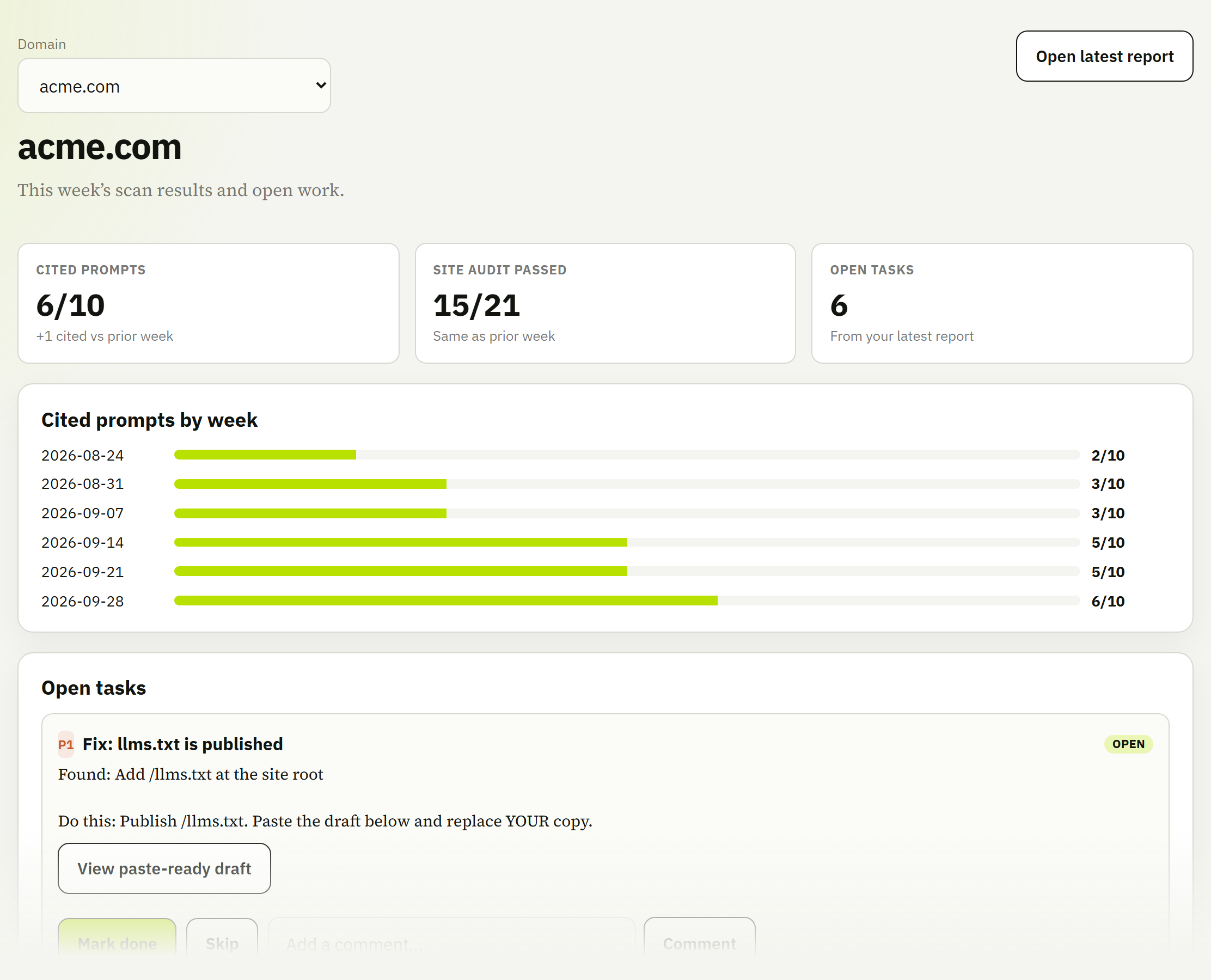
Most tools answer one of these. You need all three to know what to change next.
A blocked crawler beats good content every time. We check robots rules, HTTP responses, raw HTML, sitemaps, and llms.txt before suggesting a single word of copy.
For the questions your buyers type, such as category queries, competitor comparisons, and your own brand, we record whether you're named and who's named instead.
Every failed check and lost question becomes a task with what we found, what to do, and a draft where one helps. Mark it done, and the next scan confirms it.
Site audit
Before anyone rewrites a page, check the plumbing. A blocked crawler, a JavaScript-only page, or a canonical pointing somewhere else beats good content every time. The site audit runs about 40 pass/fail checks over plain HTTP, the way a crawler sees your site.
Every failed check says what we found (for example, the exact URLs returning 404) and what to
do about it. Where a file fixes it, such as robots.txt or llms.txt,
you get a paste-ready draft. We never change your site for you.
Prompt monitoring
You pick up to 10 questions per domain. Each week we check whether answer engines name you for them, which rival they name instead, and which sources sit behind the answer.
We suggest a starting set from your domain. You edit it before the first run and can change it later. Tracking the wrong questions wastes the whole exercise.
Weekly, not daily. Answers shift from day to day, so one weekly run gives you a trend you can act on instead of alerts you learn to ignore.
For each tracked question, whether each engine named you, and which rival it named instead.
The URLs behind the answer: pages that mention you, and the pages you'd need to appear on.
When you're cited, which page did the work, so you know what to keep fresh.
A suggested action for each lost question, such as an answer-first page, a comparison page, or an outreach pitch, with a draft you can edit.
Nobody outside the labs knows exactly how a model picks its sources, so we don't sell you a proprietary score and call it science.
Instead we measure things you can observe and fix: whether crawlers get a 200 instead of a 403, whether your copy exists without JavaScript, whether your key pages are in a sitemap, and whether you're named for the questions you care about.
Those were the mechanics of search engines, and they're still the mechanics behind AI answers.
Search
GooglebotBingbotOAI-SearchBotAI
GPTBotClaudeBotPerplexityBotGoogle-ExtendedCCBotApplebot-ExtendedWe also make one live request with an AI-crawler user agent. If your firewall blocks it while robots.txt says Allow, you'll see it as a failed check.
People who need to explain a visibility gap to a founder, a client, or a board, and want evidence instead of a dial.
"Prompt tracking tells you that you're losing. A site audit tells you whether it's even possible to win. You need both before you touch your content."
Why we built Visibility CopilotWe're in private beta and onboarding a small number of teams. Once you're invited, your first report costs $2 plus taxes, and you only subscribe if it's useful.